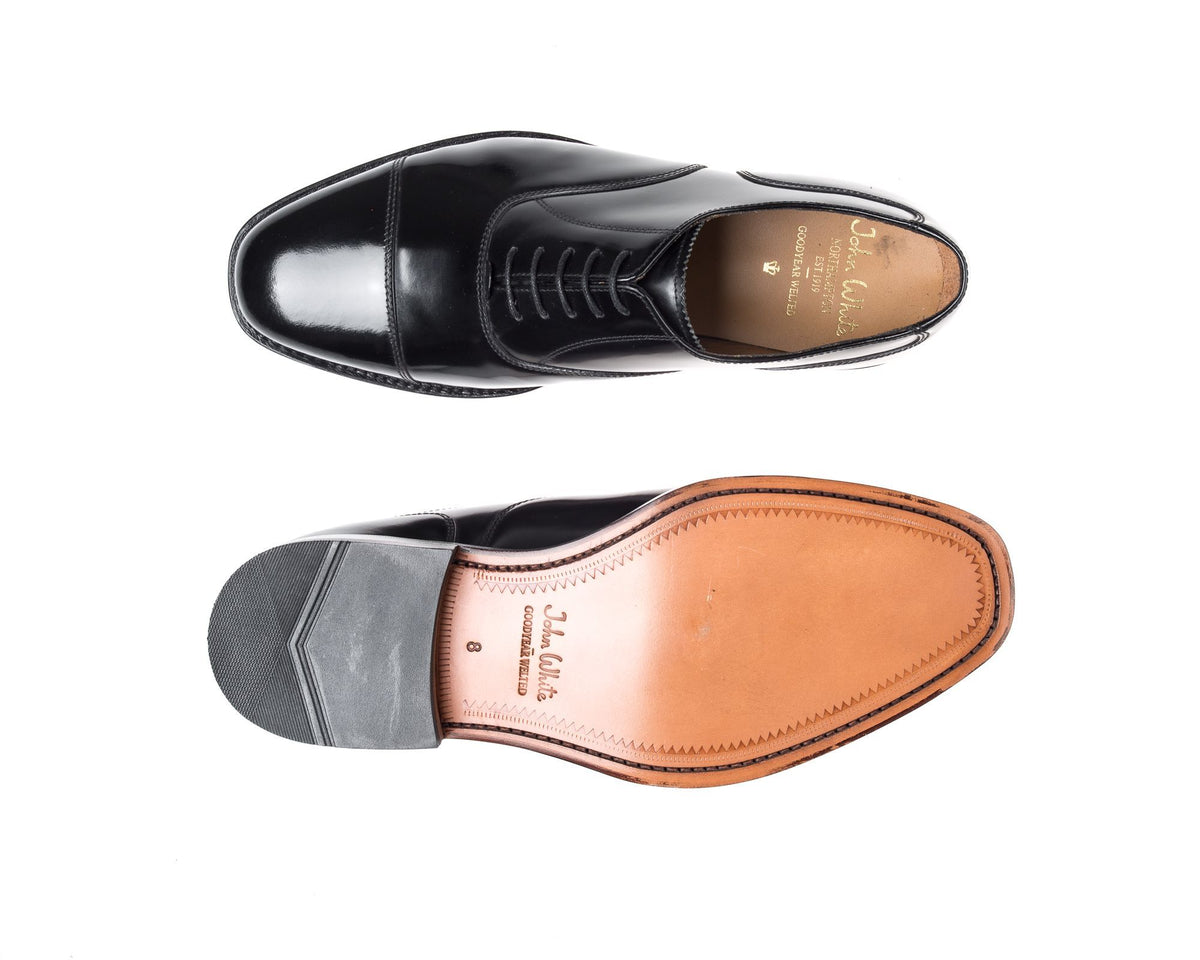
The black on the Sergeant is worked up to a hard, wet-looking shine straight out of the box, nearer a parade shoe than the soft matte of an unfinished calf. That cuts both ways: it needs almost nothing from you to look right, but it will not build a patina the way a duller leather does, and a deep scuff sits on the surface where brushing will not hide it.
The pattern is a straight cap Oxford, five eyelets, facings closed under the vamp so the lacing pulls to a neat point at the throat. No punching, no medallion, no seam that is not doing structural work. Inside, the lining and insole are a natural pale tan, left undyed.
The Sergeant is Goodyear welted, one of only three John White models in this range carrying a welt we can verify. The shoe says so itself: GOODYEAR WELTED is stamped into the sole, and the sock lining repeats it beneath the Northampton and 1919 heritage marks. John White's specification gives a leather outsole over a cushioned insole. A welt means that sole can be cut away and a fresh one sewn on with the upper left alone, more than once. John White's own guidance is that a welt is not automatically better than a Blake stitch, only different; what it gives you is a repair any cobbler is set up to do.
Sizes are UK 6 to 12 in whole sizes only, and no half sizes are made in this model at all. The width follows John White's standard F. Designed in Northamptonshire, where the firm made its name in 1930 with the Impregnable, launched nationally on a full-page Daily Mail advertisement that cost £1,200. Production stood at a million and a quarter pairs a year by then, against a hundred thousand in 1921. Its plain-toed, open-laced counterpart is the Turner.
Care: A damp cloth removes most marks from a finish this hard. Use black wax sparingly, buff rather than build, and keep the welt seam clean with a small brush. Cedar trees after every wear.
You can ask any question about this product.
Our specialists will answer you shortly!
The black on the Sergeant is worked up to a hard, wet-looking shine straight out of the box, nearer a parade shoe than the soft matte of an unfinished calf. That cuts both ways: it needs almost nothing from you to look right, but it will not build a patina the way a duller leather does, and a deep scuff sits on the surface where brushing will not hide it.
The pattern is a straight cap Oxford, five eyelets, facings closed under the vamp so the lacing pulls to a neat point at the throat. No punching, no medallion, no seam that is not doing structural work. Inside, the lining and insole are a natural pale tan, left undyed.
The Sergeant is Goodyear welted, one of only three John White models in this range carrying a welt we can verify. The shoe says so itself: GOODYEAR WELTED is stamped into the sole, and the sock lining repeats it beneath the Northampton and 1919 heritage marks. John White's specification gives a leather outsole over a cushioned insole. A welt means that sole can be cut away and a fresh one sewn on with the upper left alone, more than once. John White's own guidance is that a welt is not automatically better than a Blake stitch, only different; what it gives you is a repair any cobbler is set up to do.
Sizes are UK 6 to 12 in whole sizes only, and no half sizes are made in this model at all. The width follows John White's standard F. Designed in Northamptonshire, where the firm made its name in 1930 with the Impregnable, launched nationally on a full-page Daily Mail advertisement that cost £1,200. Production stood at a million and a quarter pairs a year by then, against a hundred thousand in 1921. Its plain-toed, open-laced counterpart is the Turner.
Care: A damp cloth removes most marks from a finish this hard. Use black wax sparingly, buff rather than build, and keep the welt seam clean with a small brush. Cedar trees after every wear.
You can ask any question about this product.
Our specialists will answer you shortly!