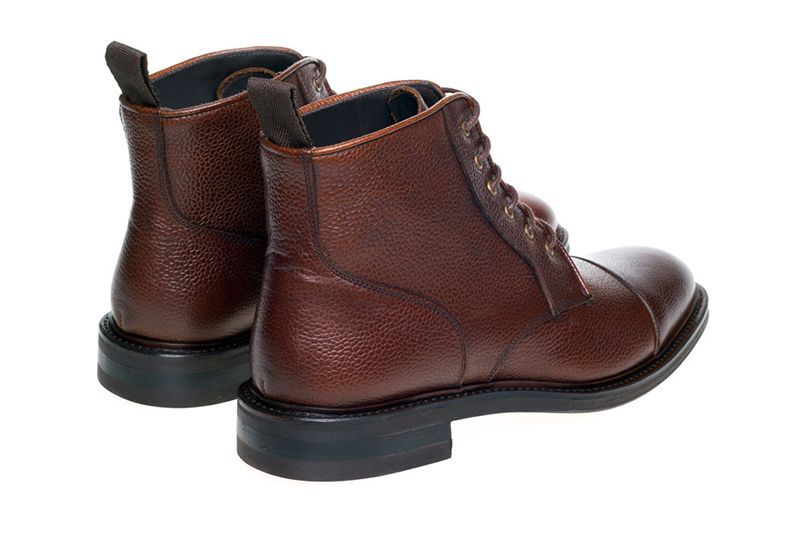
Grain is the point of the Tay. The hide carries a heavy raised pebble across the whole boot, and because colour sits unevenly in the peaks and hollows, the brown shifts from warm chestnut on the flat panels to something much darker up the shaft and deeper again over the toe cap. It will not take a mirror shine and there is no use trying; what it does instead is swallow scuffs, because a scratch has nowhere flat to sit and vanishes into the texture within a wear or two.
It is a capped derby boot: six antiqued brass eyelets a side, quarters laid over the vamp so the throat opens wide enough to get a foot in without a shoehorn, a straight cap across the toe and a woven tab at the back of the heel. The eyelets are the only metal on it, toned down rather than bright, which keeps the boot on the quiet side of workwear. Underneath is a studded rubber sole and inside a padded seat sock, both John White's own specification.
This is a boot for cold and wet months and for clothes with weight in them: heavy denim, cord, moleskin, tweed. Grain has been the sensible leather for that kind of use for a century.
Sizes run UK 7 to 12 in whole sizes, with none in between, so allow for a thicker sock. F is the standard fitting across John White's range. It is designed in Northamptonshire, where the company traded until the factory closed in 1991; the name was bought and revived by David Corben in 2000.
Care: Grain wants feeding rather than polishing. Work a cream or conditioner into the texture with a brush, and let the boot dry away from radiators if it gets soaked. A hard wax shine is not achievable here, and attempts at one just clog the grain.
You can ask any question about this product.
Our specialists will answer you shortly!
Grain is the point of the Tay. The hide carries a heavy raised pebble across the whole boot, and because colour sits unevenly in the peaks and hollows, the brown shifts from warm chestnut on the flat panels to something much darker up the shaft and deeper again over the toe cap. It will not take a mirror shine and there is no use trying; what it does instead is swallow scuffs, because a scratch has nowhere flat to sit and vanishes into the texture within a wear or two.
It is a capped derby boot: six antiqued brass eyelets a side, quarters laid over the vamp so the throat opens wide enough to get a foot in without a shoehorn, a straight cap across the toe and a woven tab at the back of the heel. The eyelets are the only metal on it, toned down rather than bright, which keeps the boot on the quiet side of workwear. Underneath is a studded rubber sole and inside a padded seat sock, both John White's own specification.
This is a boot for cold and wet months and for clothes with weight in them: heavy denim, cord, moleskin, tweed. Grain has been the sensible leather for that kind of use for a century.
Sizes run UK 7 to 12 in whole sizes, with none in between, so allow for a thicker sock. F is the standard fitting across John White's range. It is designed in Northamptonshire, where the company traded until the factory closed in 1991; the name was bought and revived by David Corben in 2000.
Care: Grain wants feeding rather than polishing. Work a cream or conditioner into the texture with a brush, and let the boot dry away from radiators if it gets soaked. A hard wax shine is not achievable here, and attempts at one just clog the grain.
You can ask any question about this product.
Our specialists will answer you shortly!