The burgundy 1130 is a dark oxblood rather than a bright claret. At arm's length it reads almost brown-black; it is only in daylight, or on the toe where the polish has built up, that the red comes through properly. That restraint is the point of it. A burgundy shoe of this depth goes everywhere a black one goes, and looks considerably better with navy, mid-grey and brown than black does.
It is the obvious second pair for anyone who already owns black shoes and wants the same shape without the same colour. Burgundy also rewards polishing more visibly than black: layers of neutral or burgundy wax deepen the toe and the heel counter over time, so the colour ends up graded rather than uniform. With grey flannel, navy chinos, olive or denim it is easy; with a black suit it is not, and black is the better buy if that is the wardrobe.
The 1130 is an apron-front Gibson. The seam runs round the toe and back up the vamp, raised proud of the leather on either side of it and picked out in a heavier stitch than the rest of the upper. It is the only decoration on an otherwise plain shoe, and it is what separates the 1130 from the rest of the military range. Open derby lacing gives room across the instep.
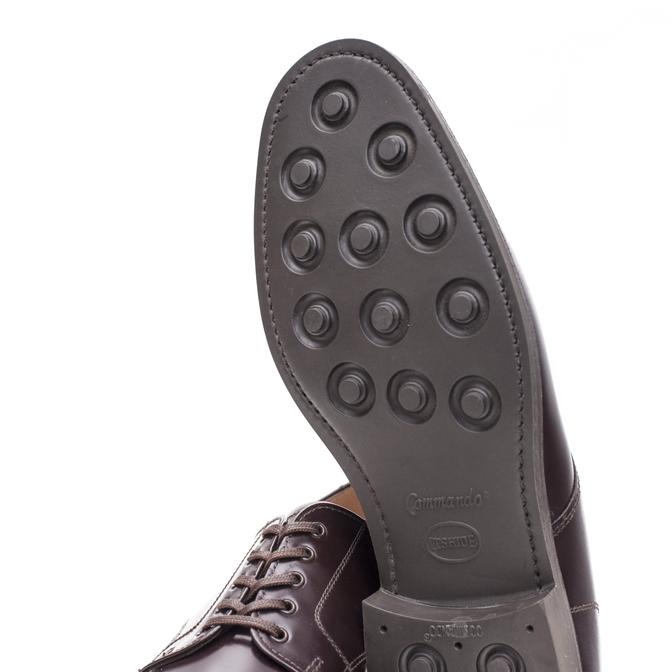
Construction is Goodyear welted: the upper is stitched to a welt, the sole is stitched to the welt, and the shoe can be resoled as often as the upper lasts without the maker's original work being undone. Underneath is a studded rubber sole with a matching rubber heel — more grip on a wet pavement than leather gives, and a good deal slower to wear down. The shoe is leather lined, in an F (standard) fitting, UK 6 to 12.
Sanders & Sanders was founded in Rushden, Northamptonshire in 1873 by the brothers William and Thomas Sanders, and has been in the Spencer Road factory on the edge of the town since 1912. The military association is real rather than decorative: during the First World War the factory was turning out close to 6,000 pairs of army boots a week, and Sanders still make a uniform range — parade boots, officers' Wellington boots, cap Oxfords — alongside the civilian collection.
Care: Brush after wearing, and feed the leather every few wears with a cream polish — burgundy or neutral, depending on whether you want the colour held or allowed to deepen. Wax on the toe and heel builds the shine. Keep polish from drying in the apron stitching. Use shoe trees overnight, rest the shoes a day between wears, and pick grit out of the studded sole when it collects.
You can ask any question about this product.
Our specialists will answer you shortly!
The burgundy 1130 is a dark oxblood rather than a bright claret. At arm's length it reads almost brown-black; it is only in daylight, or on the toe where the polish has built up, that the red comes through properly. That restraint is the point of it. A burgundy shoe of this depth goes everywhere a black one goes, and looks considerably better with navy, mid-grey and brown than black does.
It is the obvious second pair for anyone who already owns black shoes and wants the same shape without the same colour. Burgundy also rewards polishing more visibly than black: layers of neutral or burgundy wax deepen the toe and the heel counter over time, so the colour ends up graded rather than uniform. With grey flannel, navy chinos, olive or denim it is easy; with a black suit it is not, and black is the better buy if that is the wardrobe.
The 1130 is an apron-front Gibson. The seam runs round the toe and back up the vamp, raised proud of the leather on either side of it and picked out in a heavier stitch than the rest of the upper. It is the only decoration on an otherwise plain shoe, and it is what separates the 1130 from the rest of the military range. Open derby lacing gives room across the instep.
Construction is Goodyear welted: the upper is stitched to a welt, the sole is stitched to the welt, and the shoe can be resoled as often as the upper lasts without the maker's original work being undone. Underneath is a studded rubber sole with a matching rubber heel — more grip on a wet pavement than leather gives, and a good deal slower to wear down. The shoe is leather lined, in an F (standard) fitting, UK 6 to 12.
Sanders & Sanders was founded in Rushden, Northamptonshire in 1873 by the brothers William and Thomas Sanders, and has been in the Spencer Road factory on the edge of the town since 1912. The military association is real rather than decorative: during the First World War the factory was turning out close to 6,000 pairs of army boots a week, and Sanders still make a uniform range — parade boots, officers' Wellington boots, cap Oxfords — alongside the civilian collection.
Care: Brush after wearing, and feed the leather every few wears with a cream polish — burgundy or neutral, depending on whether you want the colour held or allowed to deepen. Wax on the toe and heel builds the shine. Keep polish from drying in the apron stitching. Use shoe trees overnight, rest the shoes a day between wears, and pick grit out of the studded sole when it collects.
You can ask any question about this product.
Our specialists will answer you shortly!