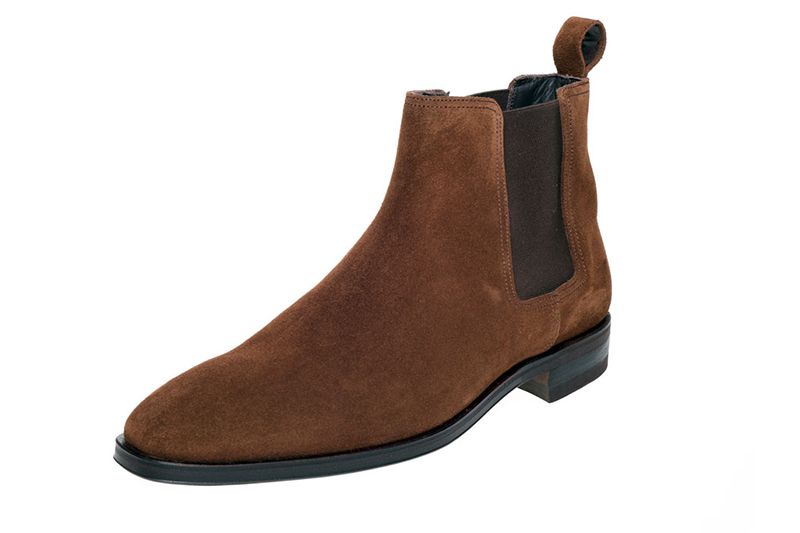
Snuff is a tobacco brown with rust in it, warmer than a chocolate suede and deeper than a tan, and the nap moves enough under the light that shaft and vamp rarely look quite the same shade. Here the gussets are a darker chocolate that stays in the same family as the upper, so the boot reads as one brown from tab to toe rather than as two, and the sole edge is dark as well. It is a quieter boot than the pale version of the same shape: the outline does the work instead of the contrast.
There is nothing on it: no toe seam, no punching, no cap, no visible branding, and a pull tab cut from the same suede as the shaft. A plain Chelsea boot lives or dies by its outline, and this one is drawn long and low on what John White call an elongated last, with a narrow almond toe over a studded rubber sole slim enough to keep the boot nearer a dress one than a country one.
Brown suede at this depth is the easiest thing to wear in the whole John White range. It goes with indigo, grey flannel, olive, cream and navy without argument, and it is forgiving where pale suede is not: the toe and flex points darken with use, but evenly enough to look deliberate.
Sizes are UK 7 to 12 in whole sizes, with none in between. Get the fit right first time, since there is no lacing to correct it later. Most of the John White range is a standard F width. Designed in Northamptonshire; John White himself stepped back in 1962, forty-three years after founding the firm in 1919, and the business merged with George Ward Holdings in 1972 to form Ward White — John White Footwear was the acquirer, buying the Leicester firm for around £4 million. The pale, two-tone alternative is the Yates in flint suede.
Care: Treat the suede with a protector before it is first worn, then repeat every few weeks once the weather turns. Brush the nap back into line after wearing, and take scuffs off with an eraser instead of water. Pack the shafts between wears so the elastic holds.
You can ask any question about this product.
Our specialists will answer you shortly!
Snuff is a tobacco brown with rust in it, warmer than a chocolate suede and deeper than a tan, and the nap moves enough under the light that shaft and vamp rarely look quite the same shade. Here the gussets are a darker chocolate that stays in the same family as the upper, so the boot reads as one brown from tab to toe rather than as two, and the sole edge is dark as well. It is a quieter boot than the pale version of the same shape: the outline does the work instead of the contrast.
There is nothing on it: no toe seam, no punching, no cap, no visible branding, and a pull tab cut from the same suede as the shaft. A plain Chelsea boot lives or dies by its outline, and this one is drawn long and low on what John White call an elongated last, with a narrow almond toe over a studded rubber sole slim enough to keep the boot nearer a dress one than a country one.
Brown suede at this depth is the easiest thing to wear in the whole John White range. It goes with indigo, grey flannel, olive, cream and navy without argument, and it is forgiving where pale suede is not: the toe and flex points darken with use, but evenly enough to look deliberate.
Sizes are UK 7 to 12 in whole sizes, with none in between. Get the fit right first time, since there is no lacing to correct it later. Most of the John White range is a standard F width. Designed in Northamptonshire; John White himself stepped back in 1962, forty-three years after founding the firm in 1919, and the business merged with George Ward Holdings in 1972 to form Ward White — John White Footwear was the acquirer, buying the Leicester firm for around £4 million. The pale, two-tone alternative is the Yates in flint suede.
Care: Treat the suede with a protector before it is first worn, then repeat every few weeks once the weather turns. Brush the nap back into line after wearing, and take scuffs off with an eraser instead of water. Pack the shafts between wears so the elastic holds.
You can ask any question about this product.
Our specialists will answer you shortly!